

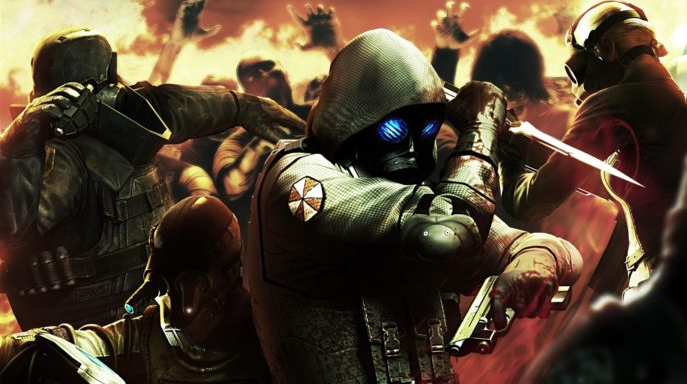
From its humble beginnings as a pharmaceutical company to its downfall as a global bioterrorism menace, the Umbrella Corporation is the most infamous entity in the Resident Evil universe. More than just a villainous organization, Umbrella’s influence spans multiple decades, directly causing zombie outbreaks, bioweapon development, and world-altering disasters.
Although Umbrella was officially dismantled in 2003, its research, technology, and legacy continue to shape the events of the series. From shady corporate conspiracies to the creation of monstrous Bio-Organic Weapons (BOWs), the company’s impact is felt in every major Resident Evil game.
In this article, we’ll break down the history of Umbrella Corporation, focusing on two major aspects: its origins and rise to power, and the catastrophic events that led to its downfall.
-
The Origins and Rise of Umbrella Corporation (1966–1997)
Umbrella Corporation was founded in 1968 by Oswell E. Spencer, James Marcus, and Edward Ashford. On the surface, the company appeared to be a pharmaceutical giant, manufacturing consumer medicines and vaccines. However, behind the scenes, Umbrella’s true goal was biological weapon development using the Progenitor Virus, an ancient strain capable of genetic mutation and enhancement.
Key events leading to Umbrella’s dominance:
- 1966 – Discovery of the Progenitor Virus: Spencer, Marcus, and Ashford find the virus in West Africa, realizing its potential for human mutation.
- 1970s – The T-Virus is developed: James Marcus experiments with Progenitor, creating the T-Virus, capable of reanimating dead tissue and enhancing living organisms.
- 1991 – Spencer Mansion and secret labs established: Spencer orders the construction of underground research facilities, including the infamous Arklay Laboratory, where experiments on the T-Virus intensify.
- 1996 – S.T.A.R.S. unit is founded: The Raccoon City Police Department (RPD) unknowingly creates an elite task force, which later investigates and exposes Umbrella’s crimes.
By the mid-90s, Umbrella had government contracts, military influence, and research labs worldwide. The corporation’s power was unmatched, but greed and ambition would lead to catastrophic consequences.
-
The Raccoon City Disaster and Umbrella’s Downfall (1998–2003)
Umbrella’s most infamous failure was the T-Virus outbreak in Raccoon City. Initially a contained experiment in the Arklay Mountains, the virus spread into the city after an accident at the underground lab, turning thousands into zombies and BOWs.
Key events of Umbrella’s downfall:
- July 1998 – Resident Evil 1: The S.T.A.R.S. team investigates Spencer Mansion, uncovering T-Virus experiments and Umbrella’s secret research. Chris Redfield and Jill Valentine survive, but Umbrella covers up the incident.
- September 1998 – Resident Evil 2 & 3: A full-scale T-Virus outbreak engulfs Raccoon City. Leon Kennedy, Claire Redfield, and Jill Valentine attempt to escape while being hunted by Umbrella’s bio-weapons, including the Tyrant and Nemesis.
- October 1998 – Raccoon City is destroyed: To prevent the virus from spreading, the U.S. government orders a missile strike, wiping out the city.
- 2003 – Umbrella officially collapses: Following multiple investigations and leaked evidence, Umbrella is shut down, and its leaders are either imprisoned or go into hiding.
While Umbrella as a company was finished, its research and influence lived on through new threats and rogue organizations.
-
Post-Umbrella Bioterrorism and Neo-Umbrella (2004–2013)
With Umbrella dismantled, former researchers and rival corporations seized the opportunity to continue bio-weapon development. While some sought profit, others wanted to use viruses for military and terrorist purposes.
Key events of Umbrella’s lingering influence:
- 2004 – Resident Evil 4: The parasite Las Plagas, created by the Los Illuminados cult, showcases a new type of biological threat outside of Umbrella’s T-Virus research.
- 2009 – Resident Evil 5: Tricell, a pharmaceutical rival of Umbrella, resurrects its viral research, leading to the creation of the Uroboros Virus. Albert Wesker, a former Umbrella researcher, attempts to use it for global domination but is ultimately stopped by Chris Redfield.
- 2012 – Neo-Umbrella emerges: A rogue scientist, Carla Radames, founds Neo-Umbrella, aiming to surpass the original company’s bioweapons. She develops the C-Virus, leading to massive outbreaks in Resident Evil 6.
While Neo-Umbrella was destroyed, bioterrorism had become a global threat, and governments worldwide struggled to contain viral outbreaks.
-
The Creation of “Blue Umbrella” and Resident Evil 7 (2017–Present)
With bioweapon technology continuing to threaten the world, an unexpected twist occurred: a new Umbrella Corporation was founded, claiming to be reformed and dedicated to fighting bioterrorism.
Key changes in the new era:
- 2017 – Resident Evil 7: Biohazard: The “New Umbrella” or Blue Umbrella is introduced as an anti-bioterror organization. Led by Chris Redfield, it appears to be working against bio-weapons rather than creating them.
- 2021 – Resident Evil Village: While Umbrella no longer exists as a villainous entity, its founder Oswell Spencer is revealed to have been inspired by Mother Miranda, connecting his early research to her experiments with the Cadou parasite.
Despite these developments, questions remain about Blue Umbrella’s true motives. Some suspect it may still be tied to the corrupt legacy of the original corporation, setting up future conflicts in the series.
-
Conclusion
The Umbrella Corporation is more than just a villainous company—it’s the foundation of the entire Resident Evil franchise. Even after its destruction, its research, bio-weapons, and unethical experiments shaped the course of history, leading to new viral threats and global bioterrorism conflicts.
Key takeaways:
- The original Umbrella (1968–2003) was responsible for the T-Virus, Raccoon City’s destruction, and global BOW research.
- Post-Umbrella threats (2004–2013), including Tricell, Neo-Umbrella, and independent terrorist groups, expanded bio-weapon use worldwide.
- Blue Umbrella (2017–Present) presents itself as a reformed organization, but its true motives remain uncertain.
Even though the original Umbrella is gone, its legacy of horror and scientific ambition continues to shape the future of Resident Evil. Whether Resident Evil 9 will reveal a final resolution or a new conspiracy remains to be seen.
For more lore and updates, visit Resident Evil’s official website.